
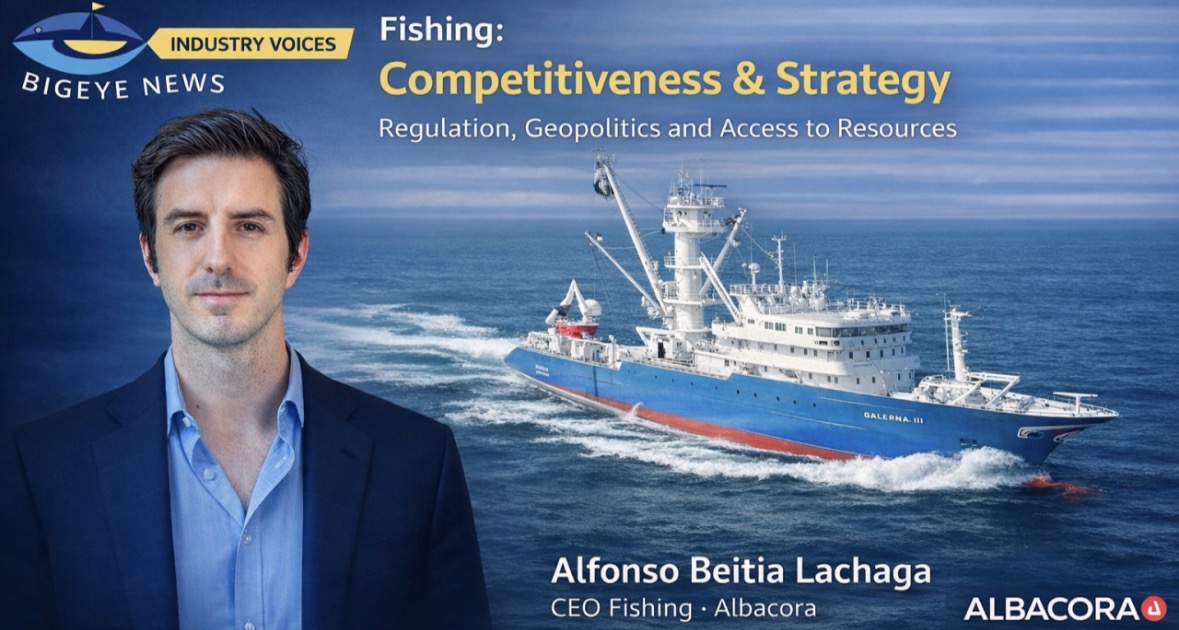
This Industry Voices edition features insights from Alfonso Beitia Lachaga, CEO Fishing at Albacora.
1. From your position leading one of the largest tuna fleets globally, how do you assess today’s competitive balance between European fleets and operators in Asia or Latin America?
We are seeing a growing competitive imbalance driven by structural factors.
On one hand, the European Union applies strict regulatory requirements in both labor and environmental areas, derived from frameworks such as Article 188 of the Control Regulation and the IUU Regulation (Illegal, Unreported and Unregulated fishing).
The issue is not the level of requirement itself, but the lack of equivalent enforcement in competing countries—many of which have neither ratified key international instruments nor implemented comparable control mechanisms.
This results in a clear case of regulatory dumping, translating into structural cost disadvantages for the European fleet.
In parallel, geopolitics is reshaping the global fishing landscape. Countries with strong negotiation capacity, access to public financing, and ocean expansion strategies are gaining presence in regions where Europe is retreating.
EU agreements are becoming increasingly difficult to conclude, while other actors move forward with more flexible frameworks and strong state support.
2. What are the key levers to maintain operational efficiency at a global fleet scale?
Operating a global fleet requires activating multiple levers simultaneously.
Fuel and logistics: We are facing a highly volatile geopolitical environment, with route closures, blocked areas, and supply restrictions in ports. This year we have seen fuel rationing situations and vessels stopped due to lack of availability. Route optimization, campaign planning, and investments in energy efficiency are essential.
Crew management and generational renewal: The shortage of qualified profiles is one of the major challenges. There is a deficit of young talent with fishing expertise, which is pushing the sector toward outsourcing and the incorporation of more non-EU crew members. This is a structural shift that requires a deep review of training systems, clear regulation, and realistic policies.
Energy transition and fleet optimization: This is a necessary objective. In this context, many countries are providing direct support for fleet modernization. In Europe, the opposite is happening: available funds such as FEMPA have been reduced, making it harder to move at the pace required by the market and already achieved by our competitors.
3. How do you see the evolution of access to fishing grounds and quotas?
Access to resources will be one of the defining issues of the coming years.
The EU is losing international presence, either voluntarily or due to lack of initiative, while other countries are increasing their weight in agreements and fishing rights, particularly in the Indian and Pacific Oceans.
This directly impacts the allocation of fishing opportunities.
New quota allocation schemes for tropical tuna are emerging, and in the coming decade we may see processes where the European fleet could significantly lose access rights if its strategy is not adjusted.
The key question is whether this decline is inevitable or whether it is the most intelligent option from a food sovereignty and competitiveness perspective.
Meanwhile, fleets such as the Chinese continue expanding their access through highly aggressive bilateral agreements.
This context requires a different strategic planning approach from Europe and a long-term vision of the role it wants to play in global oceans.
4. How is the industry adapting to margin pressure and market volatility?
There is no compatibility between increasing regulatory demands and an uneven playing field.
The sector operates under increasing costs, volatile prices, and a continuously rising regulatory burden.
The message is clear: it is incompatible to demand higher standards from European shipowners without ensuring a true level playing field for all products entering the European market.
Otherwise, those who comply are penalized while those operating under lower standards are rewarded.
In our view, it is essential to reconsider mechanisms such as duty-free quotas that flood the European market every year, and to closely monitor the frameworks affecting our product within the numerous free trade agreements currently being negotiated by the EU.
5. Looking ahead 5–10 years, what will define the leaders in the tuna industry?
Access to resources will be the key differentiator in the next decade.
Over the next five to ten years, leadership in the sector will be defined by several key factors:
Access to resources, which will be the most critical element in a world where coastal states are gaining increasing influence. Industry consolidation, which is already significant and may continue accelerating to gain scale and efficiency.
Technology applied to fleet management, data, and energy efficiency, which will determine operational performance.
Vertical integration will remain relevant, but the real inflection point will be determined by who secures stable and competitive access to fishing grounds and who can operate with controlled costs in an uneven regulatory environment.
At Group level, Albacora will continue to pursue a model that combines full traceability from sea to table with technological transformation, ensuring sustainable fishing practices.
BIGEYE NEWS · EDITORIAL PERSPECTIVE
The European tuna fleet is entering a structurally more complex competitive environment, where traditional efficiency levers are no longer sufficient on their own.
⚖️ Regulatory asymmetry as a core driver of competitive imbalance
🌍 Geopolitical repositioning redefining access to fishing grounds
🛢️ Operational resilience under fuel volatility and logistical disruption
👥 Structural labor challenges and the need for workforce transformation
📉 Margin pressure driven by cost inflation and trade dynamics
🎯 Access to resources as the ultimate strategic differentiator
What emerges is not a cyclical challenge, but a structural shift in the global tuna industry, where competitiveness will increasingly depend on geopolitical positioning, regulatory alignment, and secured access to fishing rights.