
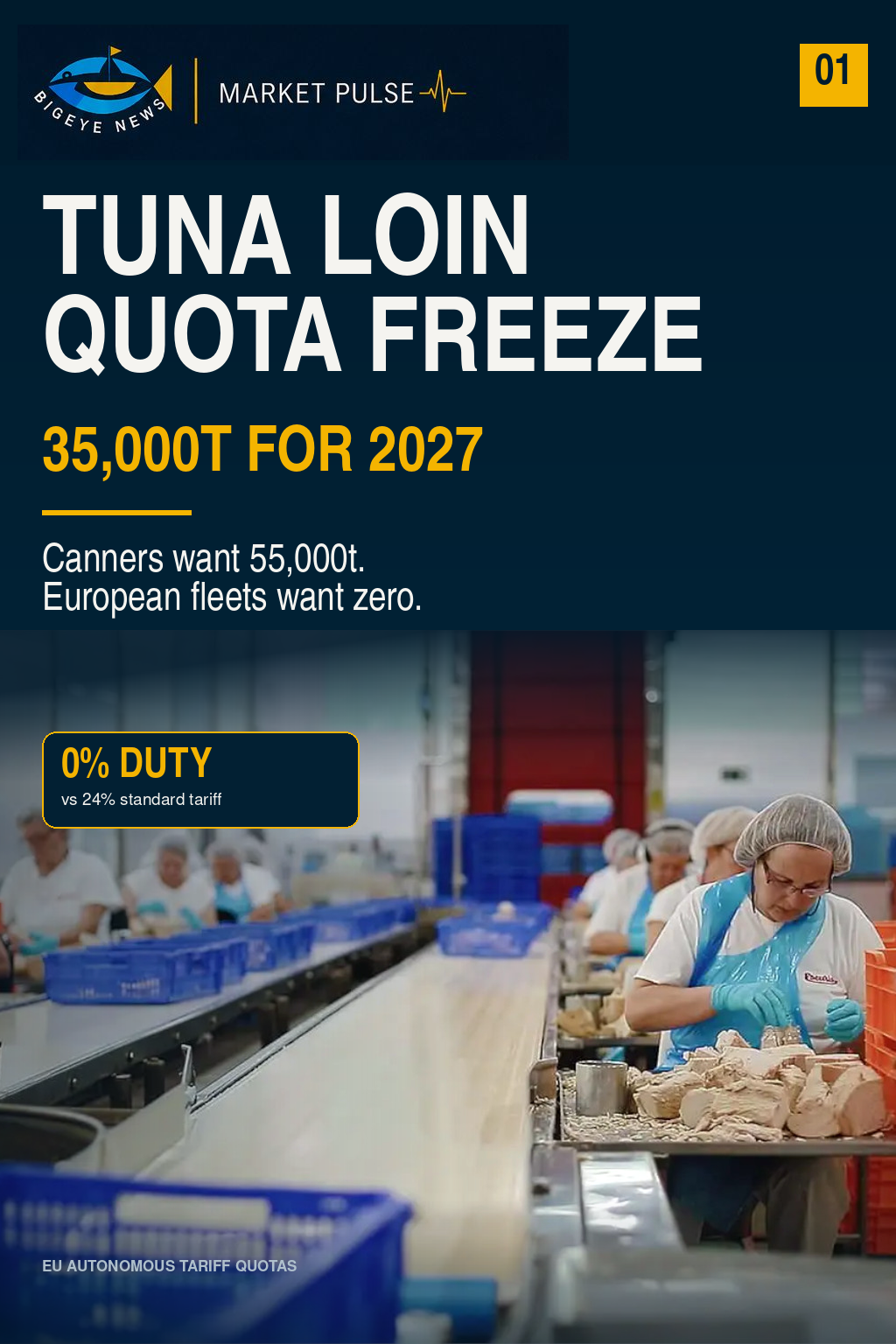


The European Commission has proposed extending the current Autonomous Tariff Quotas for fishery products until the end of 2027.
No additional volume. No new species. No sustainability conditions—yet.
For pre-cooked frozen tuna loins, the proposal maintains:
🐟 35,000t annual quota
📉 0% import duty instead of 24%
🏭 Mandatory further processing inside the EU
📅 Valid until 31 December 2027
The extension avoids a regulatory gap.
But it also postpones one of the biggest conflicts within Europe’s tuna industry.
📦 A QUOTA EXHAUSTED IN DAYS
The EU imported 174,203t of cooked frozen tuna loins in 2025, up 4.8%.
Spain alone imported:
🇪🇸 120,557t
📊 Approximately 69% of the EU total
The 35,000t quota therefore covers only around 20% of annual EU loin imports—and the entire 2026 allocation was exhausted within the first days of January.
ANFACO-CYTMA had requested an increase to 55,000t.
🏭 WHY EUROPEAN CANNERS WANT MORE
Raw material represents more than 70% of production costs for many European seafood processors.
Imported loins allow factories in Spain, Italy, France and Portugal to retain:
🥫 Final preparation and canning
📦 Packaging
🔍 Quality control
🚚 European distribution
💼 Industrial employment
The EU canned-tuna industry produces more than 370,000t annually, supplies approximately 46% of the European market and supports:
👷 20,140 direct jobs
🔗 More than 60,000 indirect jobs
The processors’ argument is simple:
If importing raw material becomes too expensive, Europe may import more finished cans—not more tuna caught by European vessels.
Retailers and Horeca operators would feel the consequences through pricing and availability, but they are not the direct users of the quota.
🎣 WHY THE EUROPEAN FLEET WANTS ZERO
Europêche Tuna Group is calling for the tuna-loin quota to be eliminated.
According to the fleet organisation, four Asian origins received 98% of quota allocations during 2020–2022:
🇨🇳 China
🇮🇩 Indonesia
🇹🇭 Thailand
🇻🇳 Vietnam
The fleet argues that cutting the tariff from 24% to zero:
📉 Places pressure on the value of EU-caught tuna
⚖️ Creates competition with lower-cost production models
🌍 Allows access without equivalent environmental and labour requirements
🤝 Adds to the preferential access already granted through trade agreements
However, the quota is not the whole import picture.
Ecuador, Papua New Guinea and several other suppliers already access the EU market under separate preferential trade arrangements.